
LA HORA — Telling Time in Spanish
Telling time in Spanish is an important topic, as it is the most common and basic conversation that you can have on the street, in the office, when taking appointments, etc.
Before moving to the topic of telling the time, we must know how to ask the time in Spanish.
Below are the different and native way of asking the time:-
- ¿Qué hora es? What time is it?
- ¿Tienes la hora? Do you have the time?
- ¿Me puedes decir la hora? Can you tell me the time?
- ¿Podrías decirme la hora? Could you tell me the time?
- ¿A qué hora…? At what time?
Note:-
- Telling the time: ¿Qué hora es? (What time is it?)
- Saying “at” a time: ¿A qué hora…? (At what time…?)
Also, When asking the time, use:
¿QUÉ HORA ES?
Not: ¿Qué tiempo es?
Here, hora means time/hour, while tiempo usually refers to time in general or weather, depending on context.
Lets talk about the structure of the how to tell time in spanish. There are two way of saying time in spanish which will depend on the hour.
- Es + La + Una + (Situation of minute hand)
- Son + Las + Any time from 2-12 + (Situation of minute hand)
1. About The Hour Hand in Spanish
Normally for hour we use the general numbers in Spanish from 1-12
1 uno
2 dos
3 tres
4 cuatro
5 cinco
6 seis
7 siete
8 ocho
9 nueve
10 diez
11 once
12 doce
Now if you want to tell the hour in Spanish, below is the example:-
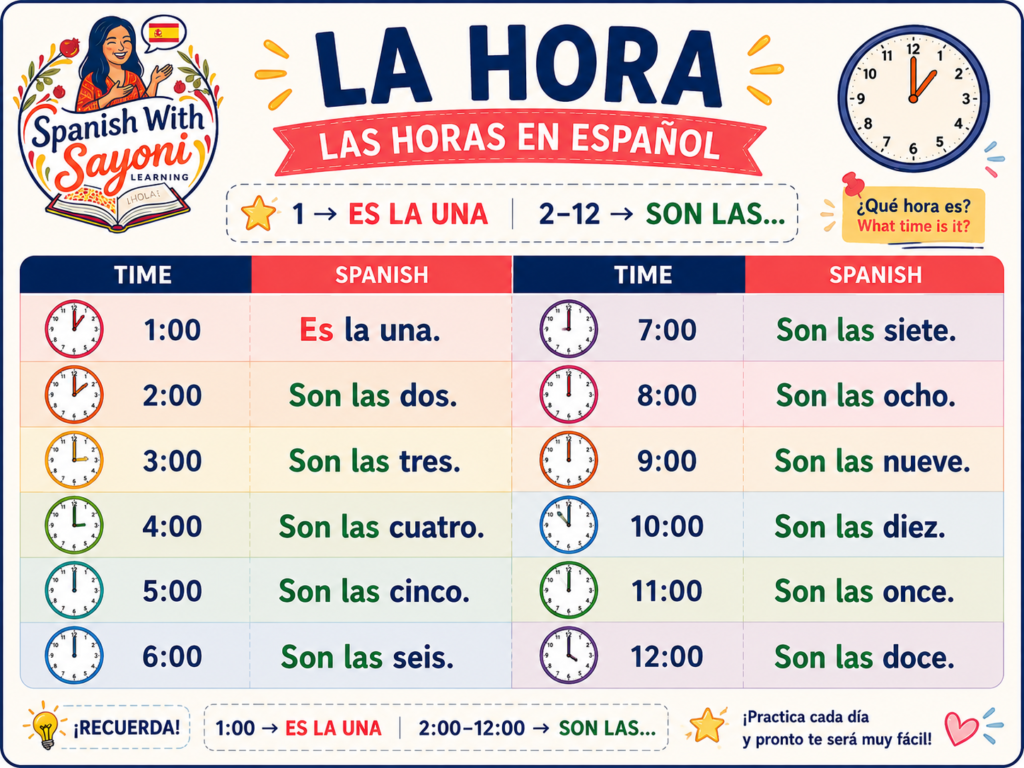
2. About The Minute Hand in Spanish
Now we know how to use the hour in time structure lets see how to use the minutes in Spanish.
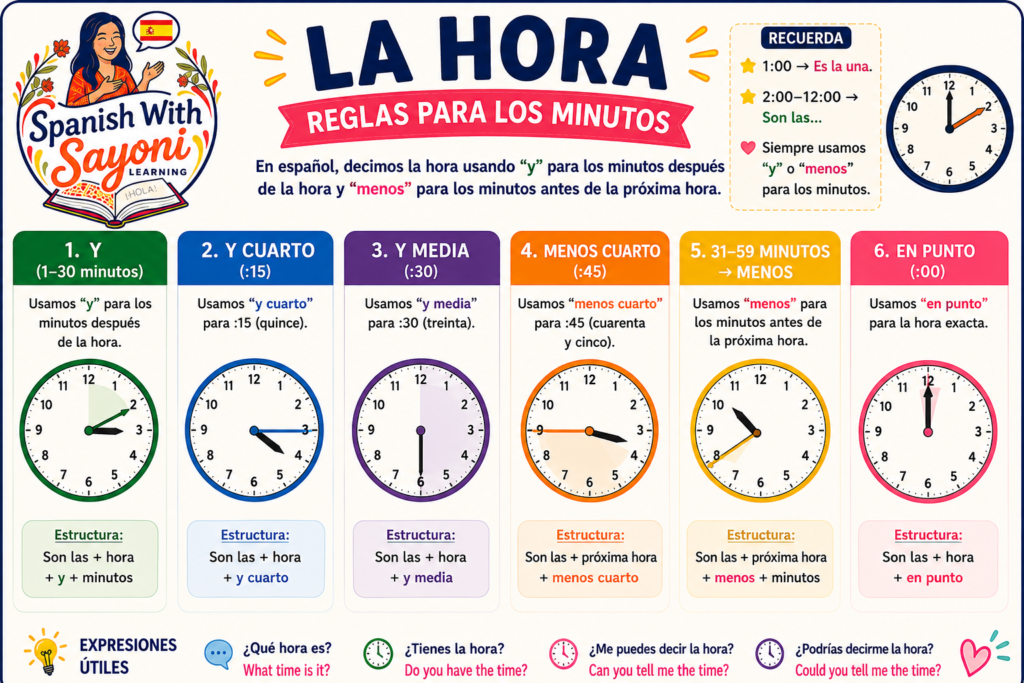
For the minute hands in 12, 3, 6, 9 and if the minute hand crosses the 30 mins we have a special rules.
Rule 1:- If you are adding normal minutes you can simply add Y and the number of the minute.
For example-
- Son las tres y cinco. → 3:05
- Son las cuatro y diez. → 4:10
- Son las siete y veinte. → 7:20
Rule 2:- If the minute hand is on 15 minutes. Use Y Cuarto
Here cuatro means quater. Rather then saying 15 minutes, Native use quater.
For example-
- 3:15- Son las tres y cuarto
- 5:15- Son las cinco y cuarto
- 1:15- Es la una y cuarto
Rule 3:- If the minute hand is on 30 minutes. Use Y MEDIA
Here media means half. Rather then saying 30 minutes, Natives use media.
For example-
- Son las dos y media. → 2:30
- Son las ocho y media. → 8:30
Rule 4:- When the minute hand is after 30 minutes: Use MENOS
For times after half past, Spanish commonly counts backward from the next hour using menos.
Next hour + menos + remaining minutes
For example-
- Son las cinco menos diez. → 4:50
- Son las diez menos veinte. → 9:40
Rule 5:- When the minute hand is on 45 minutes: Use MENOS CUARTO
Here it is the same as Rule 2, since 15 minutes are left from the preceding hour, so it says 15 minus the upcoming hour.
For example- Son las ocho menos cuarto. → 7:45
Rule 6:- When the minute hand is on 12 which is O’ clock in english, in spanish we say EN PUNTO for exact hour.
For example-
- Son las tres en punto. → It is exactly 3:00.
- Es la una en punto. → It is exactly 1:00.
So in nutshell, below is the cheatsheet to refer the rules of time when using it with hour-
3. About the Part of day : AM and PM
You can specify the part of the day:
- de la mañana → in the morning
- de la tarde → in the afternoon
- de la noche → at night
- medio día → mid day
- media noche → mid night
Examples:
Son las ocho de la mañana. → 8:00 AM
Son las tres de la tarde. → 3:00 PM
Son las nueve de la noche. → 9:00 PM
4. About the “AT” or “A” + time
Saying “at” a time: ¿A qué hora…? (At what time…?)
Use a (at) followed by la or las.
- A la una. → At 1:00.
- A las dos. → At 2:00.
- A las seis y cuarto. → At 6:15.
Rule:
- A la… → only for 1:00
- A las… → for all other hours
Practice Time:-
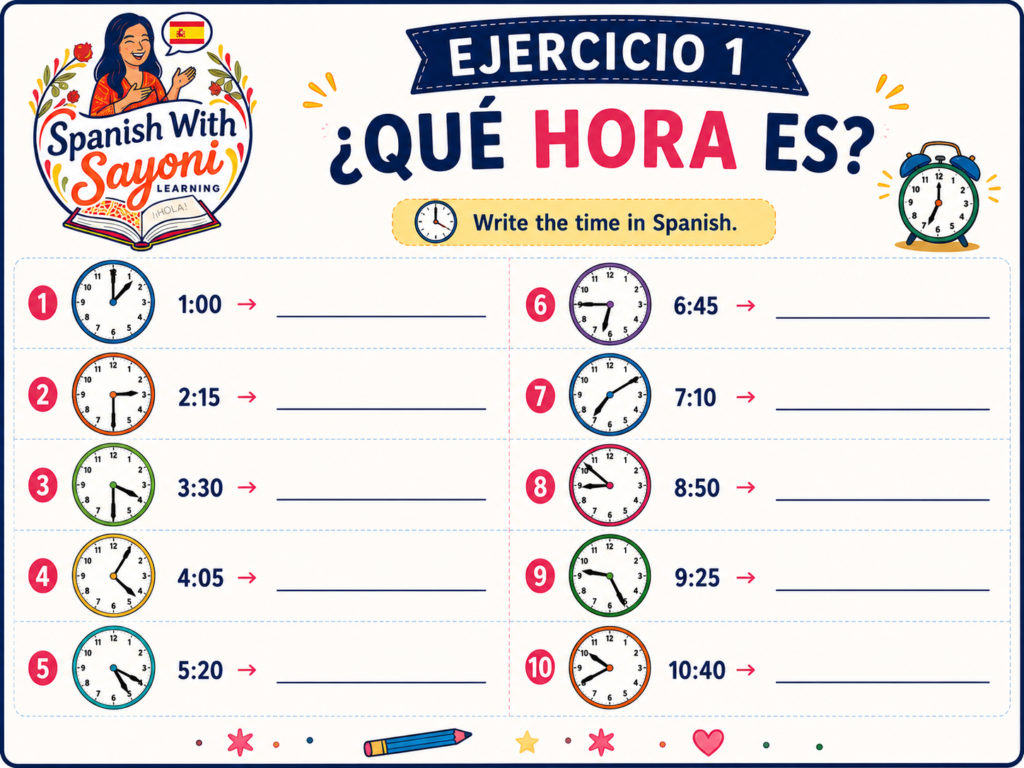
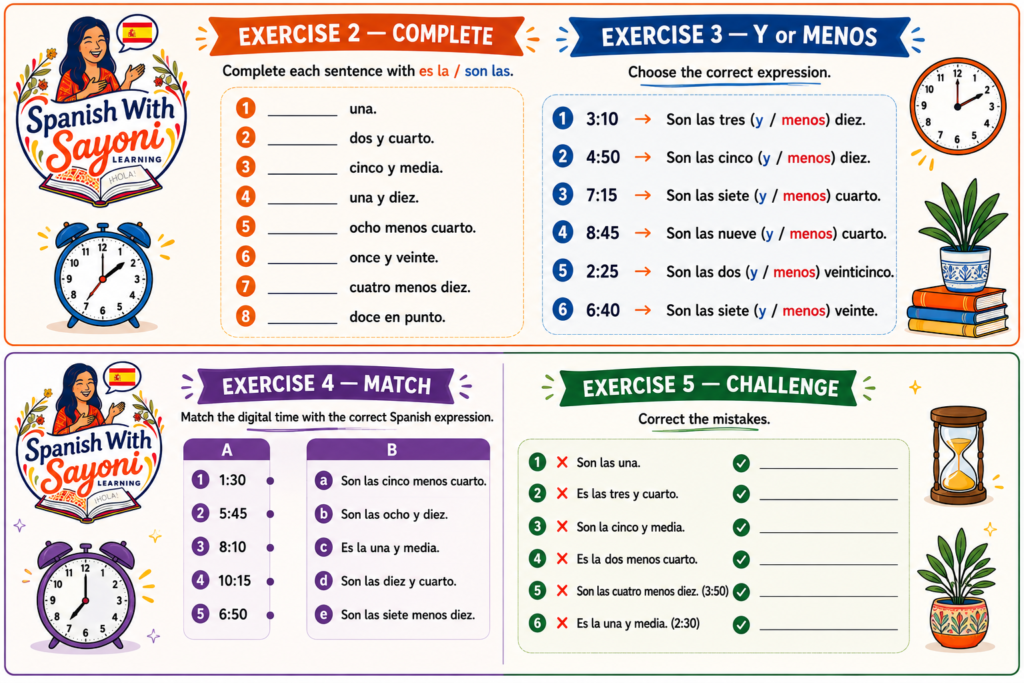
So that’s all you need to learn about the time in spanish. Now you know all the concept so let’s test your knowledge through the below exercises:-
ANSWERS:
Exercise 1:-
- 1:00 → Es la una en punto.
- 2:15 → Son las dos y cuarto.
- 3:30 → Son las tres y media.
- 4:05 → Son las cuatro y cinco.
- 5:20 → Son las cinco y veinte.
- 6:45 → Son las siete menos cuarto.
- 7:10 → Son las siete y diez.
- 8:50 → Son las nueve menos diez.
- 9:25 → Son las nueve y veinticinco.
- 10:40 → Son las once menos veinte.
Exercise 2:-
- Es la una.
- Son las dos y cuarto.
- Son las cinco y media.
- Es la una y diez.
- Son las ocho menos cuarto.
- Son las once y veinte.
- Son las cuatro menos diez.
- Son las doce en punto.
Exercise 3:-
- 3:10 → Son las tres y diez.
- 4:50 → Son las cinco menos diez.
- 7:15 → Son las siete y cuarto.
- 8:45 → Son las nueve menos cuarto.
- 2:25 → Son las dos y veinticinco.
- 6:40 → Son las siete menos veinte.
Exercise 4:-
- 1:30 → c. Es la una y media.
- 5:45 → a. Son las cinco menos cuarto.
- 8:10 → b. Son las ocho y diez.
- 10:15 → d. Son las diez y cuarto.
- 6:50 → e. Son las siete menos diez.
Exercise 5:-
- Es la una.
- Son las tres y cuarto.
- Son las cinco y media.
- Son las dos menos cuarto.
- Son las cuatro menos diez. (This sentence is actually correct, so it shouldn’t be marked as a mistake)
- Son las dos y media.
If you like this article please let me know in the comments.
Here are some other articles that you might like-
Seasons in Spanish (Las estaciones)
DIFFERENCE BETWEEN SER AND ESTAR