
Ser And Estar
Do You Know The Difference Between Ser And Estar?
As a Spanish learner and a teacher, I can totally understand the struggle of a student to differentiate between “Ser” and “Estar” in Spanish. The main issue with these two verbs is that both of them mean “To be” in English but yet the usage is very different in Spanish.
Through this article you’ll be able to understand the differences between Ser and Estar in detail and I will also tell you a shortcut to learn and memorise the rule to remember the difference between Ser and Estar.
As both of these verbs mean “To be”, Ser is more inclined towards the “Permanent things” like description, Character, nationality etc. On the other hand Estar is included towards the “Temporary things” like position, location of a person, mood etc.
So in nutshell we can say:
SER = identity and permanence
ESTAR = state and location
Before going to the differences, It’s important to know the conjugations of “Ser” and “Estar”. Below is the conjugations of “Ser” and “Estar”
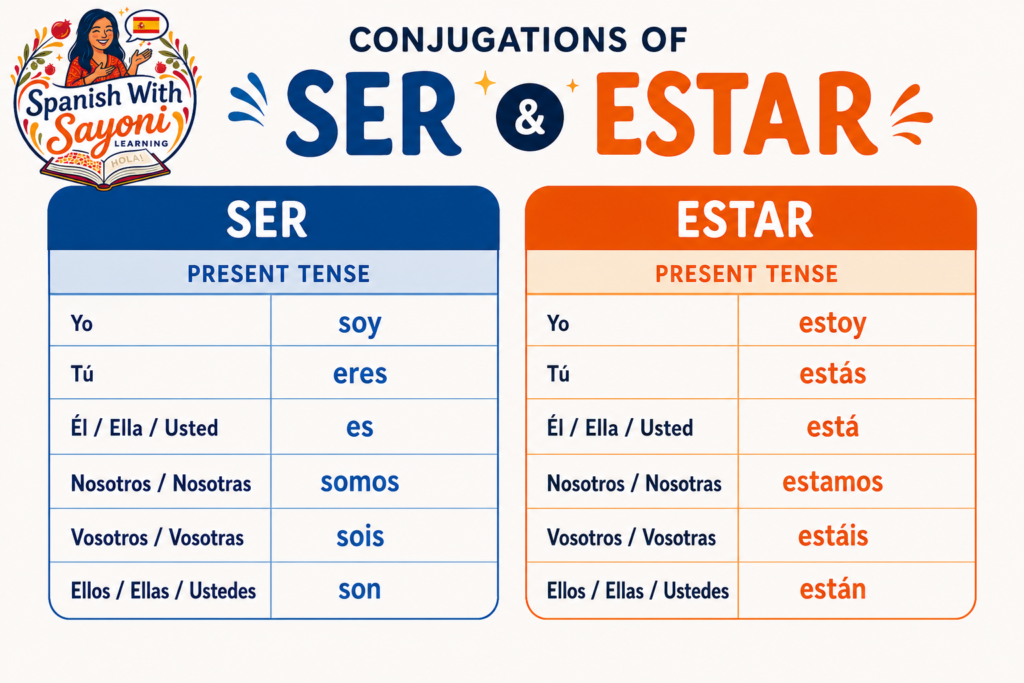
Examples of Ser:
- Yo Soy Sayoni Pandey.
- Nil y Mukesh son de India
- Ana y yo somos hermanas
Examples of Estar:
- Sayoni esta en Delhi
- El nueva York está en Estadounidense
- Lola esta trista
So, are you able to understand the usage of “Ser” and “Estar” in the examples? Don’t worry, in the next section we will understand the differences between “Ser” and “Estar” using a trick which is easy to remember. Especially when you are giving DELE exams.
An easy way to remember the Ser and Estar is the below trick:
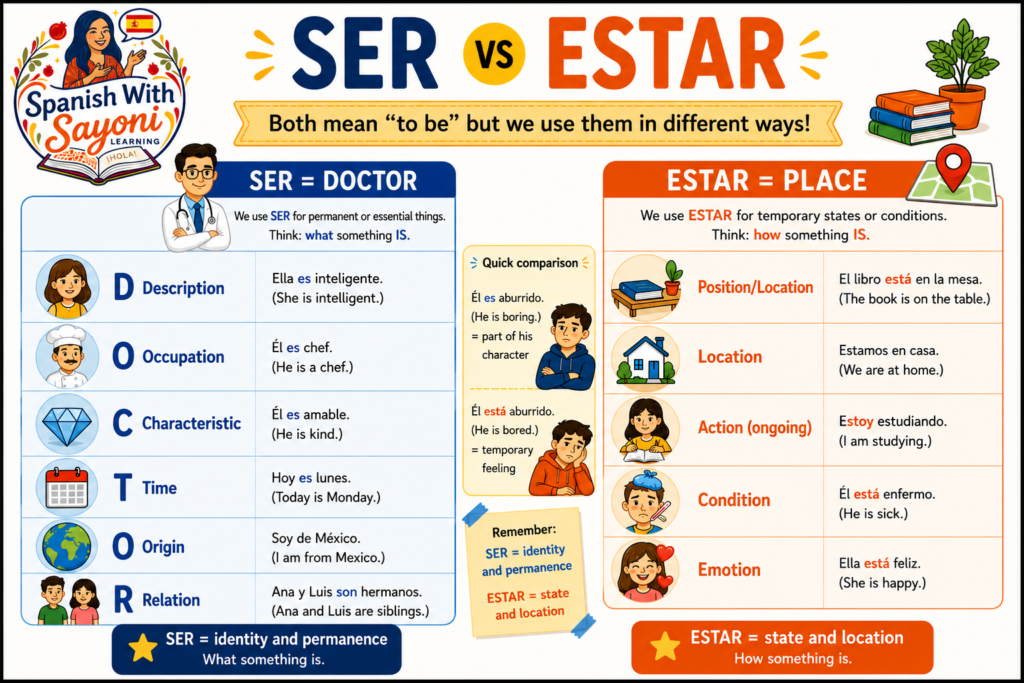
To understand it in a detailed way below is the explanation of the abbreviations:-
SER: DOCTOR
- D – Description– When we are describing a person, place or an object.
Descriptions involve physical traits, personality, and defining qualities.
Eg-
- Ella es inteligente. → She is intelligent. (Here we are talking about the personality)
- Él es alto. → He is tall. (Here we are talking about the physical traits)
- La casa es grande. → The house is big. (Here we are talking about the defining qualities)
- O — Occupation – When we are talking about the job or the work a person does. It can be jobs, professions, or roles.
Eg-
- Yo soy estudiante. → I am a student. (Here the person is full time student which is considered in this criteria because being a student is a long term process)
- Mi madre es doctora. → My mother is a doctor. (Here we are talking about the profession of mother)
- Ellos son profesores. → They are teachers. (Here also we are talking about the profession of teachers)
- C — Characteristic- When we talk about the character of a person, place or an object. Character is basically characteristics that define a person or thing.
Eg-
- El coche es rápido. → The car is fast. (Here we are talking about the speed)
- Tú eres amable. → You are kind. (Here we are talking about the nature of a person)
- El hielo es frío. → Ice is cold. (The nature of the ice ; When we think of an ice we think of its nature which is cold)
- T — Time – When we are talking about time. Logic of time is actually a separate topic in Spanish. But in order to tell the time we use the two forms of verb “Ser”. Es and Son depending on the time.
Additional knowledge:- We also use SER for below aspects-
- Time
- Dates
- Days
- Seasons
Eg-
- Es lunes. → It is Monday. (Here we are talking about the Day of the week)
- Son las tres. → It is three o’clock. (Here we are talking about the time)
- Hoy es 5 de mayo. → Today is May 5th. (Here we are talking about the date)
- O — Origin- When we talk from where the person is from or basically what their nationality is and also where do they belong from. It majorly involves the nationality, hometown, or where someone/something comes from.
Eg-
- Soy de India. → I am from India. (Here we are talking about where the person is from)
- Ella es mexicana. → She is Mexican. (Here we are talking about the nationality of the person)
- El vino es de España. → The wine is from Spain. (Here we are talking about the product and where does it belong/pertains to)
- R — Relationship- When we are talking about what relation a person share with another person or people etc. When we describe relationships between people.
Eg-
- Ella es mi hermana. → She is my sister. (Talking about the relationship between one person to another person)
- Juan y Ana son amigos. → Juan and Ana are friends. (Talking about the relationship between one person to another person)
- Él es mi profesor. → He is my teacher. (Talking about the relationship between one person to another person)
ESTAR: PLACE
- P – Position– When we are talking about the physical position of a person or of the object.
Eg:
- El gato está sentado. → The cat is sitting.
- Ella está acostada. → She is lying down.
- El libro está abierto. → The book is open.
- L- Location– When we are talking about the location of people, places, or things.
Eg:
- Estoy en casa. → I am at home.
- Madrid está en España. → Madrid is in Spain.
- Las llaves están en la mesa. → The keys are on the table.
- A — Action (ongoing)– When we are talking about the ongoing actions. This tense is called the present participle (-ando / -iendo) for actions happening right now.
Eg:
- Estoy estudiando. → I am studying.
- Ella está comiendo. → She is eating.
- Nosotros estamos aprendiendo español. → We are learning Spanish.
- C — Condition– When we are talking about temporary physical or mental conditions or the state of an object/person etc.
Eg:
- Él está enfermo. → He is sick.
- Estoy cansado. → I am tired.
- La comida está fría. → The food is cold.
- E — Emotion- When we talk about the feelings and emotions.
Examples:
- Estoy feliz. → I am happy.
- Ella está triste. → She is sad.
- Nosotros estamos nerviosos. → We are nervous.
So now you know the rules in detail when to use “Ser” and when to use “Estar”, how it’s conjugated and how to differentiate between these two verbs who have the same meaning.
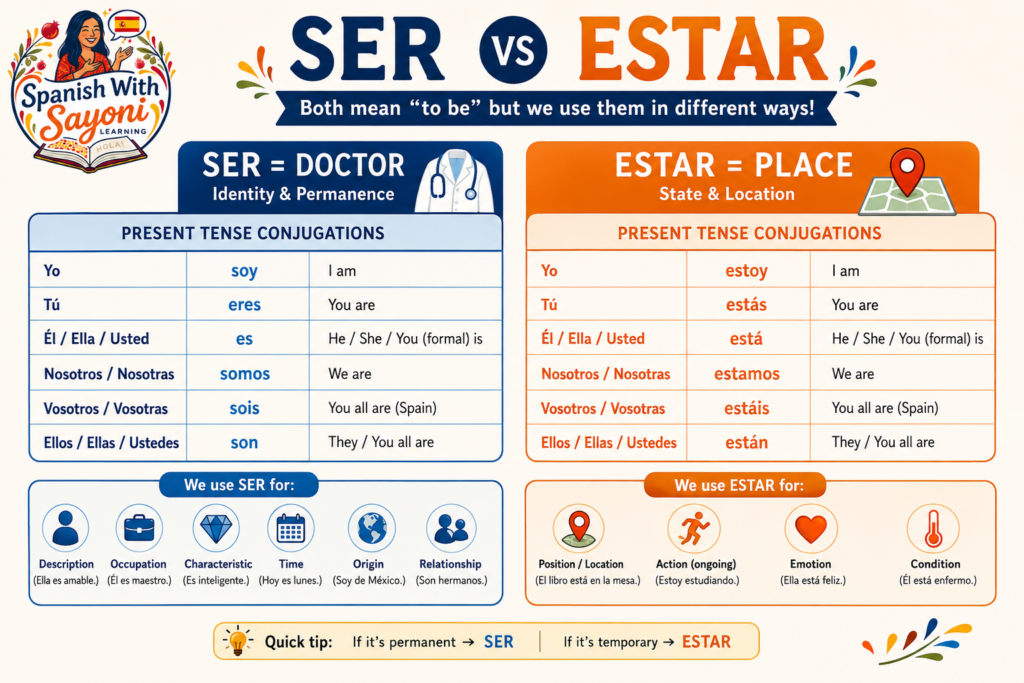
Below is the final revision on conjugation and usage of these verbs.
Now you know all the things you need to know. Now let’s practice these verbs-
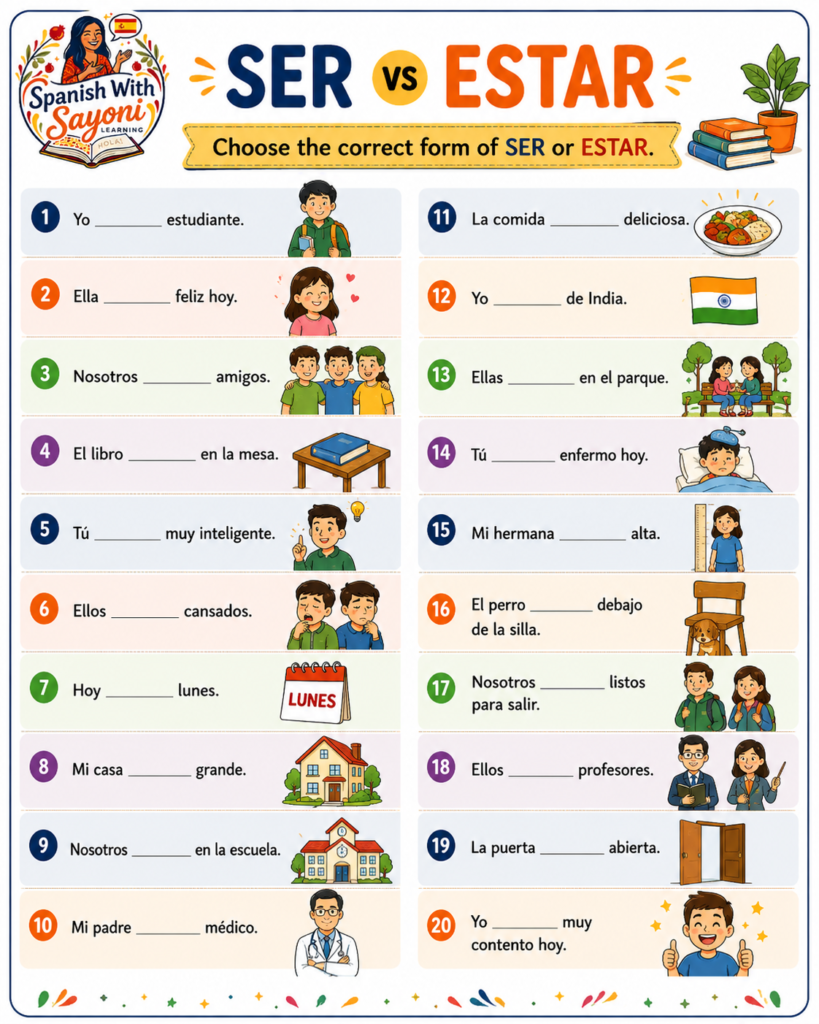
Here are the correct answers to the exercise:
- soy
- está
- somos
- está
- eres
- están
- es
- es
- estamos
- es
- está
- soy
- están
- estás
- es
- está
- estamos
- son
- está
- estoy
Now I want you guys to try this one on your own and write down the answer in the comments section:-
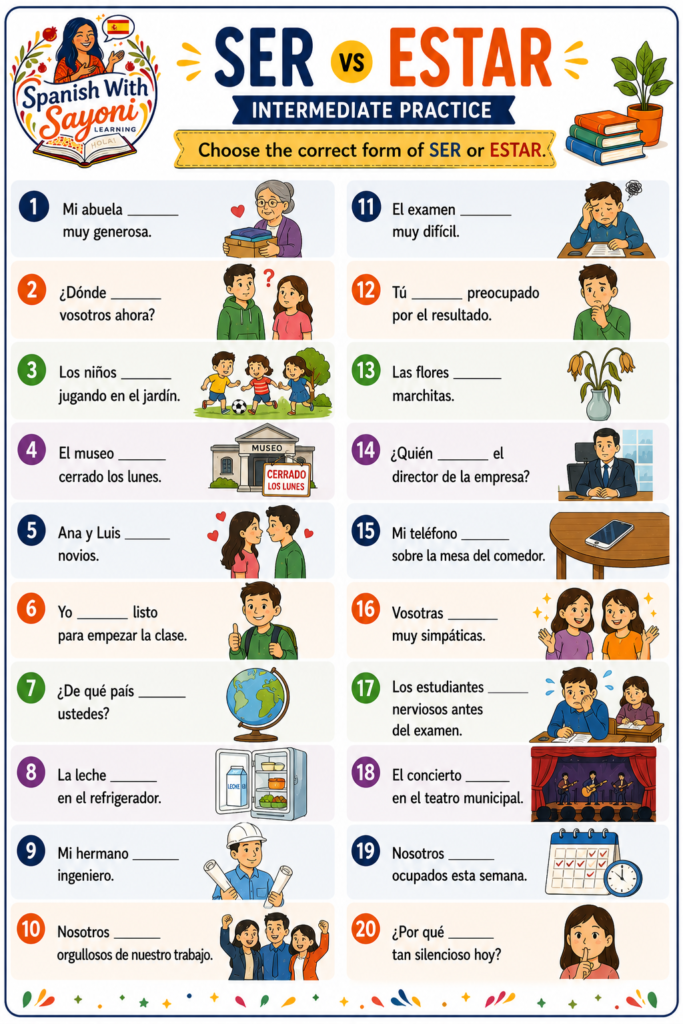
I hope this article was helpful to identify the differnce between Ser and Estar.
Comment down the answers and query in the comment section.
3 Comments
Your comment is awaiting moderation.
[…] DIFFERENCE BETWEEN SER AND ESTAR […]
Your comment is awaiting moderation.
[…] DIFFERENCE BETWEEN SER AND ESTAR […]
[…] DIFFERENCE BETWEEN SER AND ESTAR […]
[…] DIFFERENCE BETWEEN SER AND ESTAR […]
Very helpful article. I am able to identify the difference between ser and estar