Greetings and Goodbyes in Spanish (Saludos y despedidas en español)
Learning how to greet someone and say goodbye is one of the first things you should learn in Spanish. Whether you are travelling to Spain, visiting a Spanish-speaking country, meeting a new person, or simply starting your Spanish-learning journey, these everyday expressions will help you feel more comfortable speaking Spanish.
The good news? You don’t need to learn hundreds of phrases. With a few common greetings and goodbyes, you can already handle many everyday conversations.
Let’s take a look at the most useful ones.
Greetings in Spanish (Saludos en Español):-
Here are the most common greetings in spanish and their meanings in english-
Lets talk about them one by one and in which situations are they used.
1. ¡Hola! — Hello! / Hi!
Hola is probably the first Spanish word most learners come across.
It simply means “Hello” or “Hi” and can be used in both formal and informal situations.
Examples:
¡Hola, María!
Hi, María!
¡Hola! ¿Cómo estás?
Hi! How are you?
You can use hola when talking to a friend, a teacher, a colleague, or someone you have just met.
2. ¡Buenos días! — Good morning!
Buenos días means “Good morning.”
It is commonly used in the morning when greeting someone.
For example:
¡Buenos días, señor García!
Good morning, Mr. García!
You can also simply say:
¡Buenos días!
There is no need to add hola, although saying ¡Hola, buenos días! is also perfectly natural.
3. ¡Buenas tardes! — Good afternoon!
When the day moves into the afternoon, Spanish speakers commonly use buenas tardes, meaning “Good afternoon.”
For example:
¡Buenas tardes! ¿Cómo está usted?
Good afternoon! How are you?
The exact time when people switch from buenos días to buenas tardes can vary depending on the country and the situation, so don’t worry too much about a strict time.
4. ¡Buenas noches! — Good evening! / Good night!
Buenas noches is used in the evening and at night.
It can be used when you meet someone in the evening:
¡Buenas noches! ¿Cómo están?
Good evening! How are you all?
It can also be used when saying goodnight before going to bed:
Buenas noches, mamá.
Good night, Mom.
So, depending on the situation, buenas noches can mean either “Good evening” or “Good night.”
Asking Someone How They Are-
Once you’ve said hello, the next natural step is often to ask how the other person is doing.
5. ¿Cómo estás? — How are you?
¿Cómo estás? is an informal way of asking “How are you?”
You would normally use it with friends, classmates, family members, or people you are familiar with.
Hola, Ana. ¿Cómo estás?
Hi, Ana. How are you?
A common response is:
Estoy bien, gracias. ¿Y tú?
I’m fine, thank you. And you?
6. ¿Cómo está usted? — How are you? (formal)
If you are speaking formally, you can use:
¿Cómo está usted?
Here, usted is the formal form of “you.”
For example, you might hear this when speaking with someone in a formal situation:
Buenos días, señor. ¿Cómo está usted?
Good morning, sir. How are you?
Don’t worry if tú and usted seem confusing at first. As you continue learning Spanish, you’ll become more comfortable knowing when to use each one.
7. ¿Qué tal? — How are things? / How are you?
¿Qué tal? is a very common and useful expression.
It can be used in informal conversations and is similar to saying:
- How are you?
- How’s it going?
- How are things?
For example:
¡Hola! ¿Qué tal?
Hi! How’s it going?
You can keep the response simple:
Bien, gracias. ¿Y tú?
Good, thanks. And you?
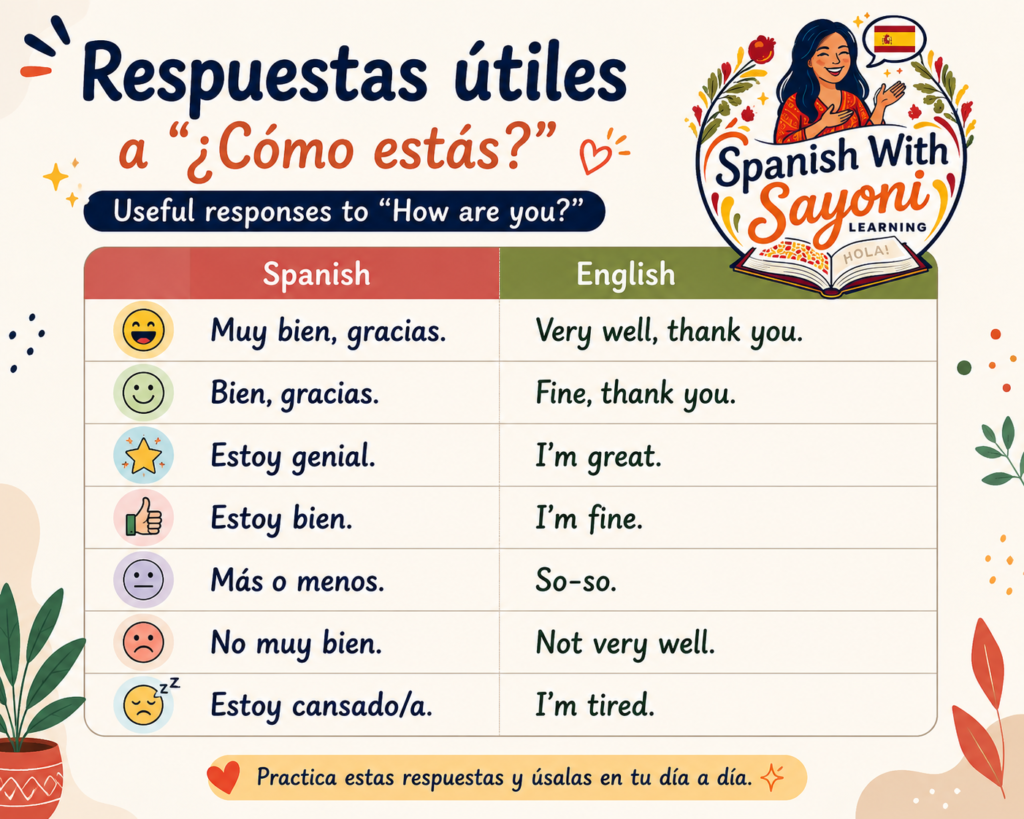
Useful Responses to “How Are You?”:-
You don’t always have to answer Estoy bien. Here are some other useful expressions
Meeting Someone for the First Time
When you meet someone for the first time, you may want to say “Nice to meet you.”
Mucho gusto. — Nice to meet you.
Mucho gusto is a common way to say “Nice to meet you.”
For example:
— Hola, soy Carlos.
— Mucho gusto.
— Hi, I’m Carlos.
— Nice to meet you.
You may also hear:
Encantado — Nice to meet you.
Encantada — Nice to meet you.
The form changes depending on the speaker.
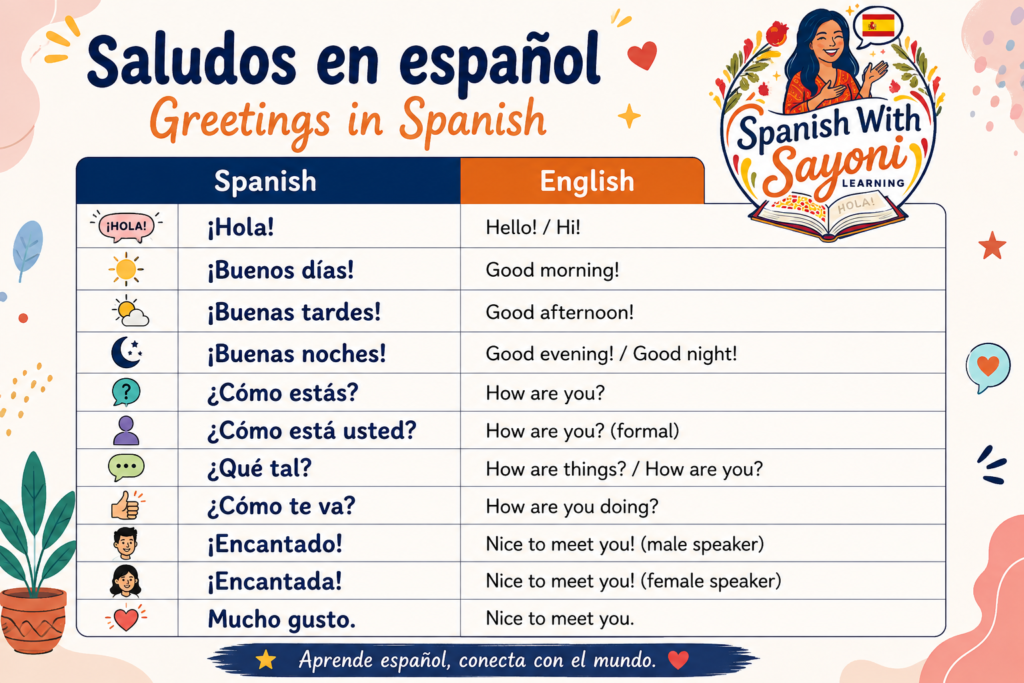
Here is a quick revision of what we have learn so far in Greetings in Spanish:-
Now lets move to the next part, Las despedidas en Espanol
Saying Goodbye in Spanish (Despedidas en español)
Now that you’ve learned how to start a conversation, let’s look at some natural ways to end one.
1. ¡Adiós! — Goodbye!
Adiós means “Goodbye.”
It is one of the most straightforward ways to say goodbye.
Bueno, tengo que irme. ¡Adiós!
Well, I have to go. Goodbye!
Although adiós is perfectly correct, Spanish speakers also use many other expressions in everyday conversations.
2. ¡Hasta luego! — See you later!
Hasta luego literally refers to seeing someone later and is one of the most useful goodbye expressions to remember.
Tengo que irme. ¡Hasta luego!
I have to go. See you later!
You don’t necessarily have to make specific plans to see the person later. It can simply be a friendly way to say goodbye.
3. ¡Hasta mañana! — See you tomorrow!
This one is easy to remember:
Hasta mañana = See you tomorrow.
¡Hasta mañana, Ana!
See you tomorrow, Ana!
Use it when you expect to see the person the next day.
4. ¡Hasta pronto! — See you soon!
Hasta pronto means “See you soon.”
¡Gracias por venir! ¡Hasta pronto!
Thanks for coming! See you soon!
5. ¡Nos vemos! — See you!
Nos vemos is another very common expression you’ll hear in everyday Spanish.
It literally means something like “We see each other,” but naturally translates as “See you!”
Bueno, me voy. ¡Nos vemos!
Well, I’m leaving. See you!
It sounds friendly and informal.
6. ¡Chao! / ¡Chau! — Bye!
Chao and chau are informal ways of saying “Bye!”
The spelling and pronunciation can vary between Spanish-speaking countries.
You may hear:
¡Chao! Nos vemos mañana.
Bye! See you tomorrow.
It’s a casual expression, so it’s especially common among friends and people you know well.
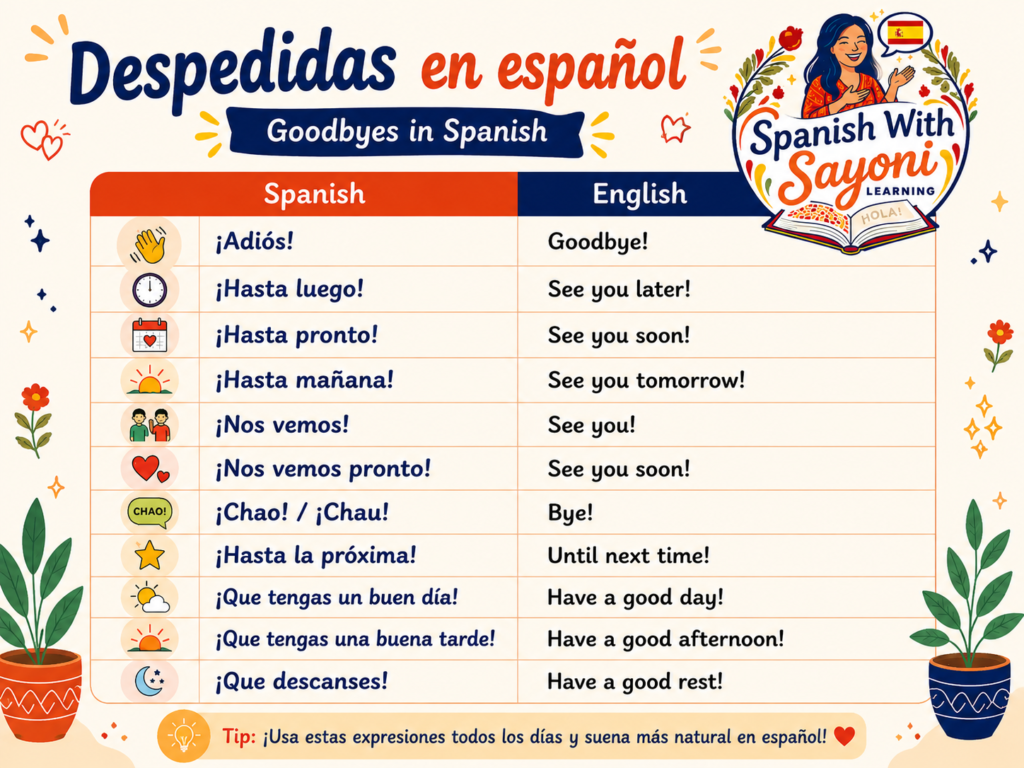
Here is a quick revision of what we have learn so far in Goodbyes in Spanish:-
A Simple Spanish Conversation
Let’s put everything together.
Ana: ¡Hola! ¡Buenos días!
Carlos: ¡Hola! Buenos días. ¿Cómo estás?
Ana: Muy bien, gracias. ¿Y tú?
Carlos: Estoy bien, gracias.
Ana: ¡Qué bien! Bueno, tengo que irme.
Carlos: Claro. ¡Hasta luego!
Ana: ¡Nos vemos!
English translation:
Ana: Hi! Good morning!
Carlos: Hi! Good morning. How are you?
Ana: Very well, thank you. And you?
Carlos: I’m fine, thanks.
Ana: That’s great! Well, I have to go.
Carlos: Sure. See you later!
Ana: See you!
Notice how simple the conversation is. You don’t need complicated Spanish to start having small conversations.
Greetings and Goodbyes: Quick Reference
Here’s a quick list to save for later:
Greetings
- ¡Hola! — Hello! / Hi!
- ¡Buenos días! — Good morning!
- ¡Buenas tardes! — Good afternoon!
- ¡Buenas noches! — Good evening! / Good night!
- ¿Cómo estás? — How are you? (informal)
- ¿Cómo está usted? — How are you? (formal)
- ¿Qué tal? — How are you? / How’s it going?
- Mucho gusto. — Nice to meet you.
Goodbyes
- ¡Adiós! — Goodbye!
- ¡Hasta luego! — See you later!
- ¡Hasta pronto! — See you soon!
- ¡Hasta mañana! — See you tomorrow!
- ¡Nos vemos! — See you!
- ¡Chao! / ¡Chau! — Bye!
When you’re learning Spanish, it’s easy to think you need to know a lot of grammar before you can actually speak. You don’t.
Start with simple expressions like ¡Hola!, ¿Cómo estás?, ¡Hasta luego!, and ¡Nos vemos! Try using them whenever you get the chance.
The more often you use these little phrases, the more natural Spanish will start to feel.
And remember: making a few mistakes is completely normal. The goal at the beginning isn’t to speak perfect Spanish. It’s to start communicating.
¡Hola! ¡Hasta luego!
If you like this article please let me know in the comments.
Here are some other articles that you might like-